The cabinets are in, the counters look right from the doorway, and your contractor says the remodel's finished. Then you run a hand across a windowsill and it comes up white. There's grit inside drawers, a film on light fixtures, and paint specks on tile that looked clean an hour ago. That's the gap post construction cleaning services are meant to close, and it's wider than most homeowners expect.
Final cleaning isn't surface polish. It's material and air control at handover. The United Nations Environment Programme overview of waste pollution reports that construction and demolition activities generate more than one-third of all waste produced by society. Your home won't contain that scale of debris, but the same mix shows up in miniature: fine dust, packaging, offcuts, adhesive, and residue settled across floors, ledges, cabinets, and vents. If you restart the HVAC system too early or move furniture in before that dust is removed in the right order, you spread it into places that are much harder to clean later.
I treat a final clean as an occupancy decision, not a cosmetic one. A room can photograph well and still shed dust for days. The work below separates what cleaning can deliver, what it can't certify, and how to sequence it so you don't pay for the same pass twice.
Table of Contents
- [Post-Construction Cleaning Stages and Who Handles Them](#post-construction-cleaning-stages-and-who-handles-them)
- [How the Stages Play Out on a Real Job](#how-the-stages-play-out-on-a-real-job)
- [How to Run a Final Clean in the Right Order](#how-to-run-a-final-clean-in-the-right-order)
- [The Eight-Step Sequence](#the-eight-step-sequence)
- [What Done Actually Looks Like](#what-done-actually-looks-like)
- [Equipment That Separates Final Cleaning from Housekeeping](#equipment-that-separates-final-cleaning-from-housekeeping)
- [Registers, Microfiber, and Buyer Checks](#registers-microfiber-and-buyer-checks)
- [Dust, Silica and Air Safety During Final Cleaning](#dust-silica-and-air-safety-during-final-cleaning)
- [Why Silica Changes the Method](#why-silica-changes-the-method)
- [Stop Rules Every Crew Should Follow](#stop-rules-every-crew-should-follow)
- [Who Is Responsible for Dust, Lead and Clearance](#who-is-responsible-for-dust-lead-and-clearance)
- [What the Rules Actually Require](#what-the-rules-actually-require)
- [The Rule to Apply at Handover](#the-rule-to-apply-at-handover)
- [Choose a Provider and Book the Final Clean](#choose-a-provider-and-book-the-final-clean)
- [Seven Checks Before You Sign](#seven-checks-before-you-sign)
- [Booking Steps That Prevent Handover Problems](#booking-steps-that-prevent-handover-problems)
<a id="post-construction-cleaning-stages-and-who-handles-them"></a>
Post-Construction Cleaning Stages and Who Handles Them
Say you've just finished a 1,900 sq ft Orlando kitchen and bath remodel. The tile crew left yesterday, the painter touched up trim this morning, and you want to move back in this weekend. A single cleaning visit booked for Friday won't cover what's in the house. You'll likely need stages, even if the same company handles most of them.
Construction leaves material where routine housekeeping never looks. Drywall dust settles on tops of door frames, light fixtures, vent covers, and inside cabinets. Sawdust collects behind appliances. Adhesive and paint specks bond to floors and glass if they're left to cure under grit. Each stage removes a different layer, and skipping the early one makes the later passes slower and less effective.
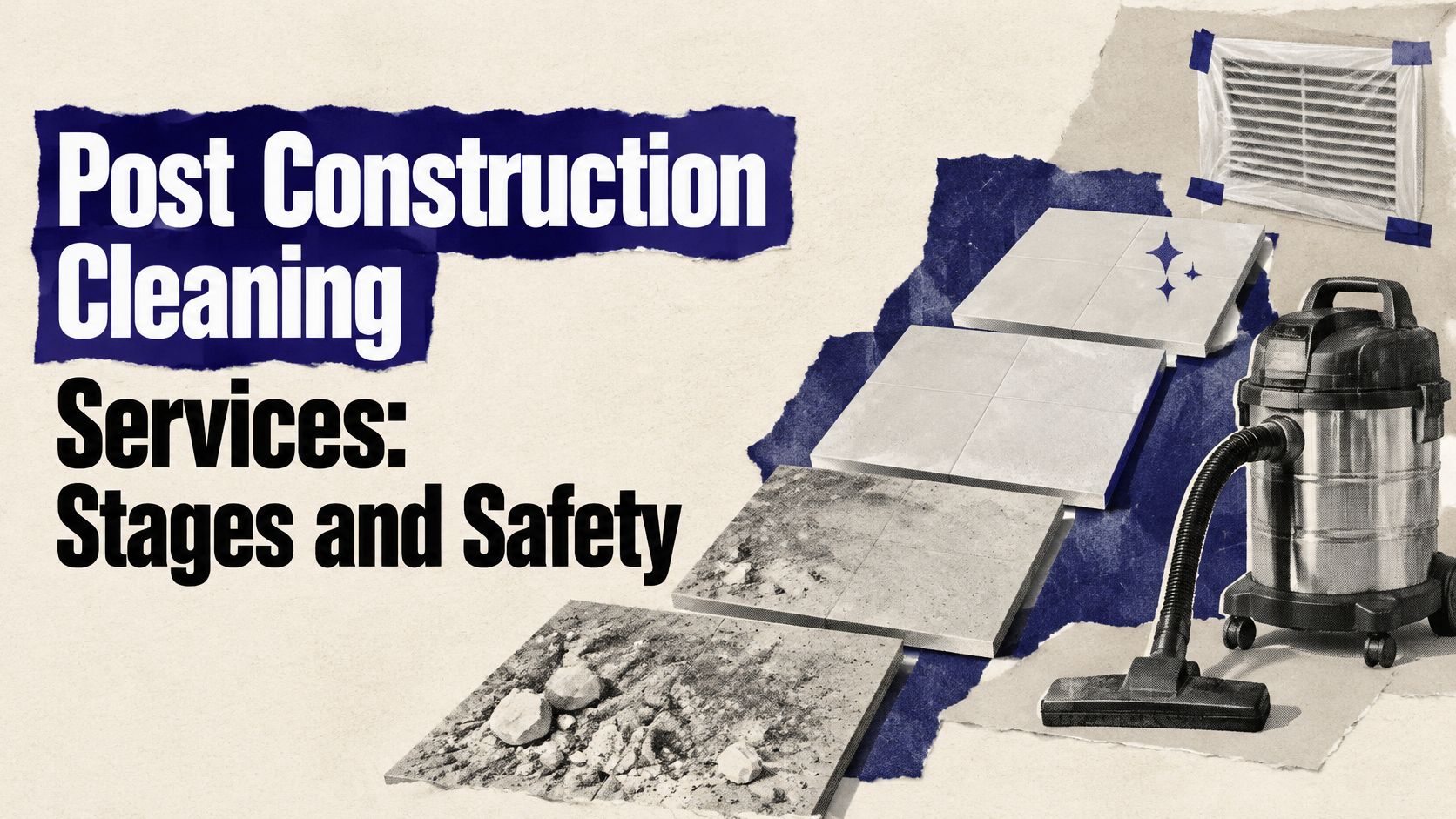
| Stage | When it happens | Main tasks | Usually done by |
|---|---|---|---|
| Rough clean | Right after the last trade leaves | Remove bulk debris, packaging, offcuts and loose plaster | General site cleaner or crew |
| Dust removal | After rough clean, before HVAC restarts | HEPA vacuum from ceilings downward, damp-wipe surfaces | Post-construction cleaning specialist |
| Final clean | One to two days before inspection or move-in | Fixtures, glass, cabinets, then floors last | Post-construction cleaning specialist |
| Punch-list touch-up | After the inspector's walk-through | Fix missed spots, fingerprints and fresh residue | Same cleaning team on a return visit |
<a id="how-the-stages-play-out-on-a-real-job"></a>
How the Stages Play Out on a Real Job
In that Orlando example, the rough clean might remove about a dozen bags of packaging, offcuts, and loose debris before anyone touches a microfiber cloth. The dust pass takes most of a day because every horizontal surface needs vacuuming and damp wiping, often twice. The final clean is a shorter half-day pass focused on finished surfaces, glass, fixtures, and floors once the heavy particulate load is gone.
Timing matters more than speed. Dust removal should happen before the HVAC system restarts, so settled particles aren't pulled into return air pathways. The final clean belongs close to inspection or move-in, not a week earlier when trades, inspectors, or delivery crews will track through again. The touch-up exists because walk-throughs create fingerprints, shoe marks, and fresh dust from opening cabinets and windows.
If any trade is still cutting, sanding, or painting on site, the property isn't ready for final cleaning. Move the date.
Run that check today. Walk room by room and note unfinished caulk lines, uninstalled hardware, or tools still plugged in. If you find active work, you're at rough clean stage at best, and scheduling a final clean now guarantees re-dusting.
<a id="how-to-run-a-final-clean-in-the-right-order"></a>
How to Run a Final Clean in the Right Order
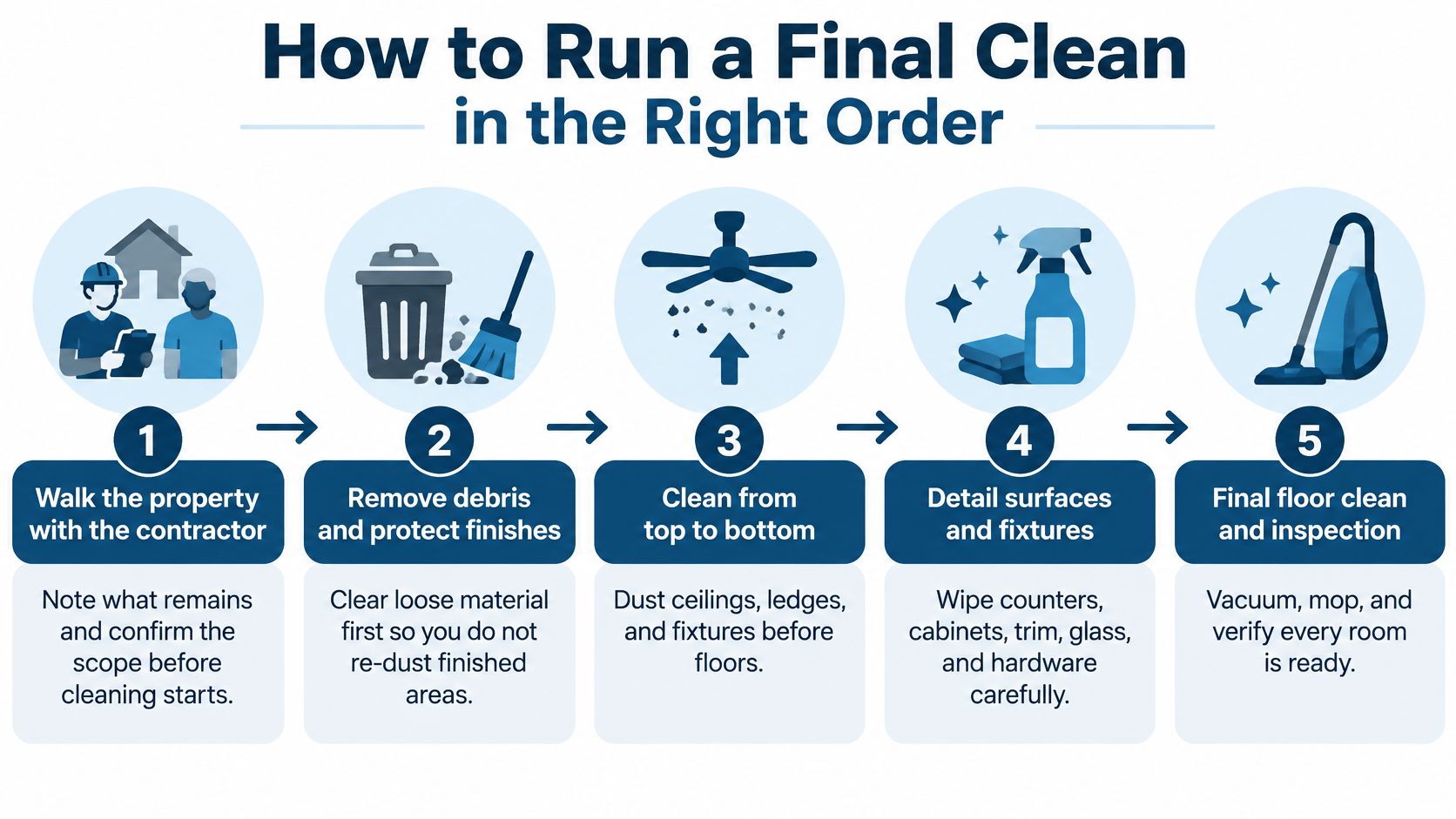
Most failed final cleans don't fail from laziness. They fail from sequence. Someone mops early, then dusts a ceiling fan, and the floor needs doing again. The order below prevents that loop, and it's the same logic behind how a professional house cleaning is structured step by step, tightened for construction dust.
<a id="the-eight-step-sequence"></a>
The Eight-Step Sequence
1. Walk the property with the contractor. Note what remains, confirm which rooms are finished, and photograph problem areas like paint on tile or adhesive on floors. Those photos set scope and protect everyone if a finish was already damaged.
2. Remove bulk debris by hand into bags. Pick up packaging, offcuts, and loose material instead of sweeping it across new floors. Dragging debris pushes grit into corners and scratches finishes.
3. Vacuum high surfaces first. Start with ceilings, beams, light fixtures, and high ledges using a soft brush attachment. Dust falls, so anything you clean below this point before now will need redoing.
4. Damp-wipe walls and trim. Work over door frames, window sills, tops of doors, and baseboards with a lightly damp microfiber cloth. Dry wiping smears drywall dust into a paste-like film that's harder to lift.
5. Detail cabinets, appliances, and fixtures. Clean inside and outside cabinets and drawers, then appliance exteriors, vanities, sinks, tubs, and plumbing fixtures. Construction dust hides in drawer runners and shelf corners, so vacuum those voids before wiping.
6. Wash glass with clean solution. Do windows, mirrors, and shower glass, changing water often. Dirty water leaves streaks that only show up when sunlight hits at an angle, which is usually after the crew has left.
7. Clean floors last. Vacuum thoroughly, including edges and corners, then damp mop with fresh heads. Mopping before the dust passes above are done guarantees you'll mop again.
8. Inspect under raking light. Stand in a doorway with light coming across surfaces at a low angle and check sills, counters, and floors. Log what was done room by room so a touch-up crew knows where to focus.
<a id="what-done-actually-looks-like"></a>
What Done Actually Looks Like
Done isn't a feeling. Run a finger across a windowsill and it should come away clean, with no white film. Check outlets and switch plates for grit, open cabinets and look for dust lines where doors sat closed, and view glass from the side for haze. I would also check the top of the refrigerator and the highest shelf in each closet. Those spots reveal whether the crew worked top to bottom or just cleaned what was easy to reach.
If floors feel gritty under socks after mopping, dust is still migrating from above or from an adjoining unfinished room. Don't keep mopping. Find the source surface first, vacuum and wipe it, then redo the floor once.
<a id="equipment-that-separates-final-cleaning-from-housekeeping"></a>
Equipment That Separates Final Cleaning from Housekeeping
Extra effort with the wrong vacuum doesn't fix fine dust. Equipment is the dividing line, and the key specification is a sealed HEPA vacuum. The EPA guidance on air duct cleaning and indoor dust defines HEPA performance as capturing 99.97% of particles at 0.3 microns, with the vacuum designed so intake air passes through the HEPA filter without bypass leakage.
Think of a conventional shop vacuum fitted with a replacement HEPA-style filter like a leaking bag. It can pick up visible debris while air slips around the filter and exhausts fine particles back into the room. You end up moving dust from the floor into the air, where it resettles on the cabinets you just wiped. A purpose-designed sealed machine prevents that bypass, which is why filter rating alone isn't enough. The housing and seals matter as much as the filter inside.
| Equipment | Job it does | What to check |
|---|---|---|
| Sealed HEPA vacuum | Captures fine particles from floors, ledges and surfaces | Sealed housing and a HEPA filter with no bypass around it |
| HEPA shop vacuum | Removes coarse debris and bulk dust only | Not used as the main tool for fine dust |
| Microfiber cloths and mop heads | Trap dust instead of spreading it | Fresh, unused heads for each room |
| Extension pole and dusting head | Reaches ceilings, beams and light fixtures | Adjustable reach and soft head |
| Two-bucket damp-wipe system | Removes residue without redepositing it | Clean water changed between rooms |
| Plastic sheeting and tape | Isolates work zones and sealed registers | Registers fully covered before dust work starts |
<a id="registers-microfiber-and-buyer-checks"></a>
Registers, Microfiber, and Buyer Checks
Seal supply and return registers before dust work starts and keep the HVAC system off until cleanup is complete. That single step keeps fine particles out of ducts, where they'd otherwise blow back into finished rooms for weeks. It's cheap, fast, and frequently skipped.
We arrive with commercial-grade vacuums, fresh microfiber mop heads, and safe sanitizing supplies, so you don't need to supply equipment or chemicals. Our specialists also bring their own professional-grade products, microfiber cloths, HEPA vacuums, and specialized tools. If you're comparing providers, or checking which house cleaning supplies a crew should bring, run three checks before booking:
- Ask for the vacuum make or model: A specific answer signals real equipment, not a household upright.
- Confirm it's a sealed HEPA unit: Ask directly whether air can bypass the filter.
- Ask about fresh microfiber per room: Reused cloths redeposit dust from the last surface onto the next.
Close with one question: which vacuum will the crew use in rooms with finished cabinetry? The answer should be the sealed fine-dust machine, not the coarse-debris shop vacuum.
<a id="dust-silica-and-air-safety-during-final-cleaning"></a>
Dust, Silica and Air Safety During Final Cleaning
Dry sweeping a room full of construction dust feels productive. It's usually the worst option. A broom launches fine particles back into the air, where they stay suspended and settle on everything you've already cleaned. Compressed air is worse. Both turn settled dust you could have captured into airborne dust you'll breathe and redistribute.
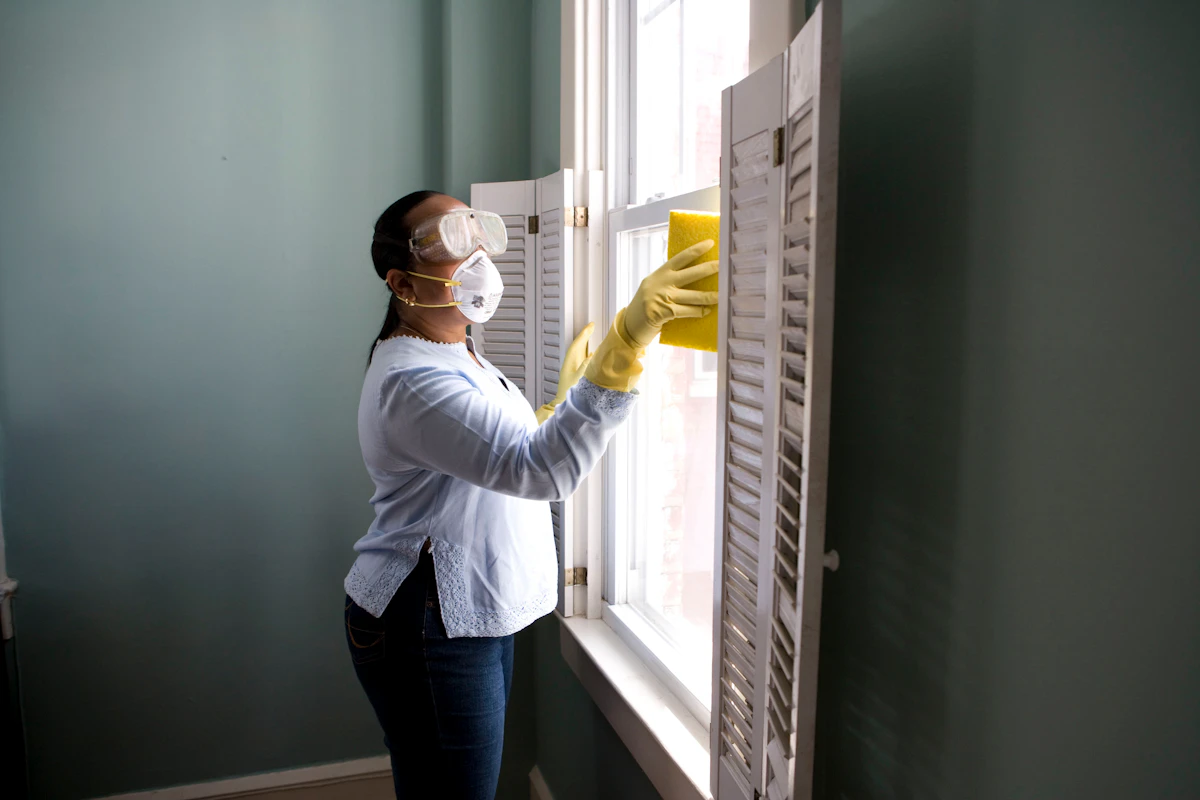
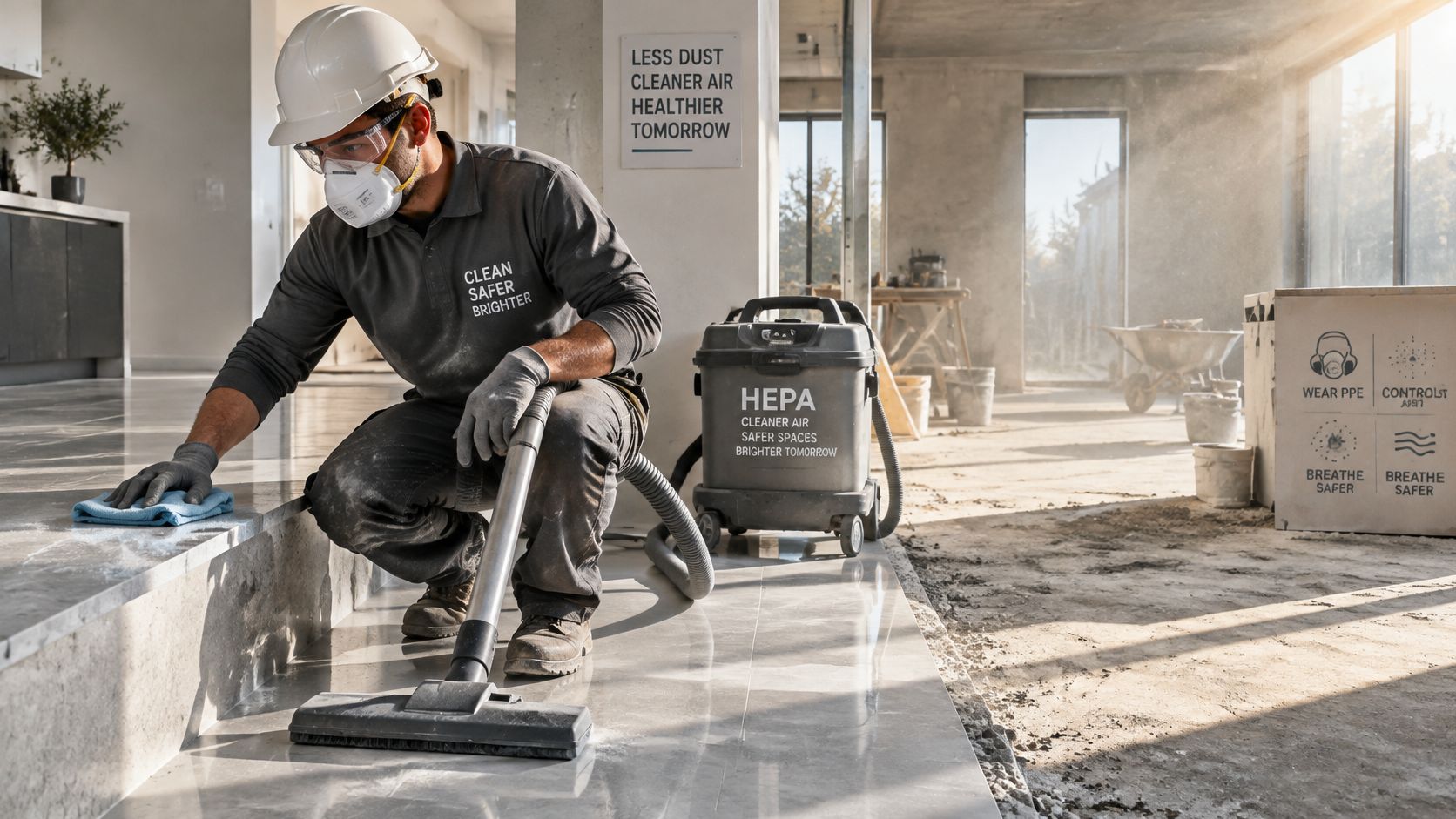
The worker vacuuming under controlled conditions below shows the posture and equipment this work requires, slow passes with a sealed machine rather than fast sweeping.
<a id="why-silica-changes-the-method"></a>
Why Silica Changes the Method
Cutting, grinding, drilling, or demolishing concrete, mortar, tile, and stone can generate respirable crystalline silica. The U.S. Occupational Safety and Health Administration construction silica guidance sets an action level of 25 micrograms per cubic meter and a permissible exposure limit of 50 micrograms per cubic meter, both calculated as an eight-hour time-weighted average for covered construction exposures. Those thresholds are occupational limits, not household cleaning standards. They still show the scale of concern, because dust accumulates indoors where dispersion is impeded and air circulation is limited.
Practical controls during final cleaning are straightforward. Use wet methods where surfaces allow it, close doors to isolate finished rooms from unfinished ones, run exhaust ventilation to the outdoors rather than recirculating air, and wear a fitted respirator when dust is visibly airborne. Vacuum and damp-wipe settled dust. Don't create new airborne dust to remove old dust.
The short video below is a useful visual check on how dust behaves during cleanup and why containment matters before you start wiping finished surfaces.
<iframe width="100%" style="aspect-ratio: 16 / 9;" src="https://www.youtube.com/embed/gMtAdr-Fm48" frameborder="0" allow="autoplay; encrypted-media" allowfullscreen></iframe>
<a id="stop-rules-every-crew-should-follow"></a>
Stop Rules Every Crew Should Follow
Say a crew arrives at a 1950s bungalow where painted trim has been sanded and old paint is chipping along sills. The right move is to stop, close the room, and call for testing before any final clean continues. A cleaning visit shouldn't disturb suspected lead paint or asbestos to meet a move-in deadline.
Stop and request a professional assessment when you find:
- Airborne dust that won't settle: Ventilation runs, but haze and grit keep returning.
- Chipping or peeling old paint: Especially on trim, sills, and doors in older homes.
- Suspected asbestos material: Older flooring, pipe insulation, or textured material being disturbed.
- Visible mold growth: Cleaning around it can spread contamination to finished areas.
Division of responsibility: A final clean supports visible readiness and responsible dust removal. Controlling dust at the source during cutting and demolition remains the contractor's and employer's job.
That boundary protects you. If a provider offers to sand, scrape, or tear out suspect material as part of a cleaning package, that's a reason to pause, not a bonus.
<a id="who-is-responsible-for-dust-lead-and-clearance"></a>
Who Is Responsible for Dust, Lead and Clearance
A sparkling clean does not equal clearance. That's the misconception that causes the most trouble at handover, because homeowners, landlords, and agents hear move-in ready and assume a regulated standard has been met. Ordinary cleaning, cleaning verification, and clearance testing are different outcomes, performed by different parties.
Say a landlord hands over a 1970s duplex after repainting and floor work. The unit looks spotless, but a child's bedroom has chipped paint along the windowsill. A visible clean doesn't settle whether lead dust on that sill or floor is within limits. Only sampling does, and sampling isn't part of a standard cleaning visit.
<a id="what-the-rules-actually-require"></a>
What the Rules Actually Require
For renovation work covered by the federal Renovation, Repair and Painting framework, the EPA frequent questions on renovations covered by the RRP Rule say the area must be cleaned until no dust, debris, or residue remains, and firms must make their best effort to remove paint chips and dust even when perfect cleaning is difficult. For lead clearance, the cited limits are 40 micrograms per square foot on floors and 250 micrograms per square foot on window sills.
Those numbers are measured, not judged by eye. Dust collects on horizontal surfaces, so floors, window sills, countertops, mantels, and shelving are the places to check and, where testing applies, to sample. A white-glove test can pass on a countertop while a sill in the same room fails, which is why visual inspection alone can't substitute for a wipe sample.
| Party | Controls | Does not certify |
|---|---|---|
| Builder or contractor | Containment and dust control during the work | Final clearance results |
| Cleaning company | Removing visible debris, residual dust and residue | Regulatory clearance or lead testing |
| Certified inspector or testing lab | Clearance sampling against set limits | Overall cleaning quality |
| Homeowner or landlord | Ventilation, HVAC filter replacement and final sign-off | Setting the clearance standard |
<a id="the-rule-to-apply-at-handover"></a>
The Rule to Apply at Handover
Ask each party to state, in writing, what they're confirming. The contractor confirms containment during the work. The cleaner confirms visible completion against an agreed scope, ideally with photos. An authorized inspector or test confirms whether a regulated standard has been met, when one applies.
I would not accept a cleaning quote that promises regulatory clearance, lead-safe certification, or guaranteed inspection approval from cleaning alone. That promise either misunderstands the rules or overstates what a vacuum and microfiber can prove. A careful provider will prepare the property thoroughly, document what was done, and tell you plainly when separate testing is the next step. That honesty is a quality signal, not a gap in service.
<a id="choose-a-provider-and-book-the-final-clean"></a>
Choose a Provider and Book the Final Clean
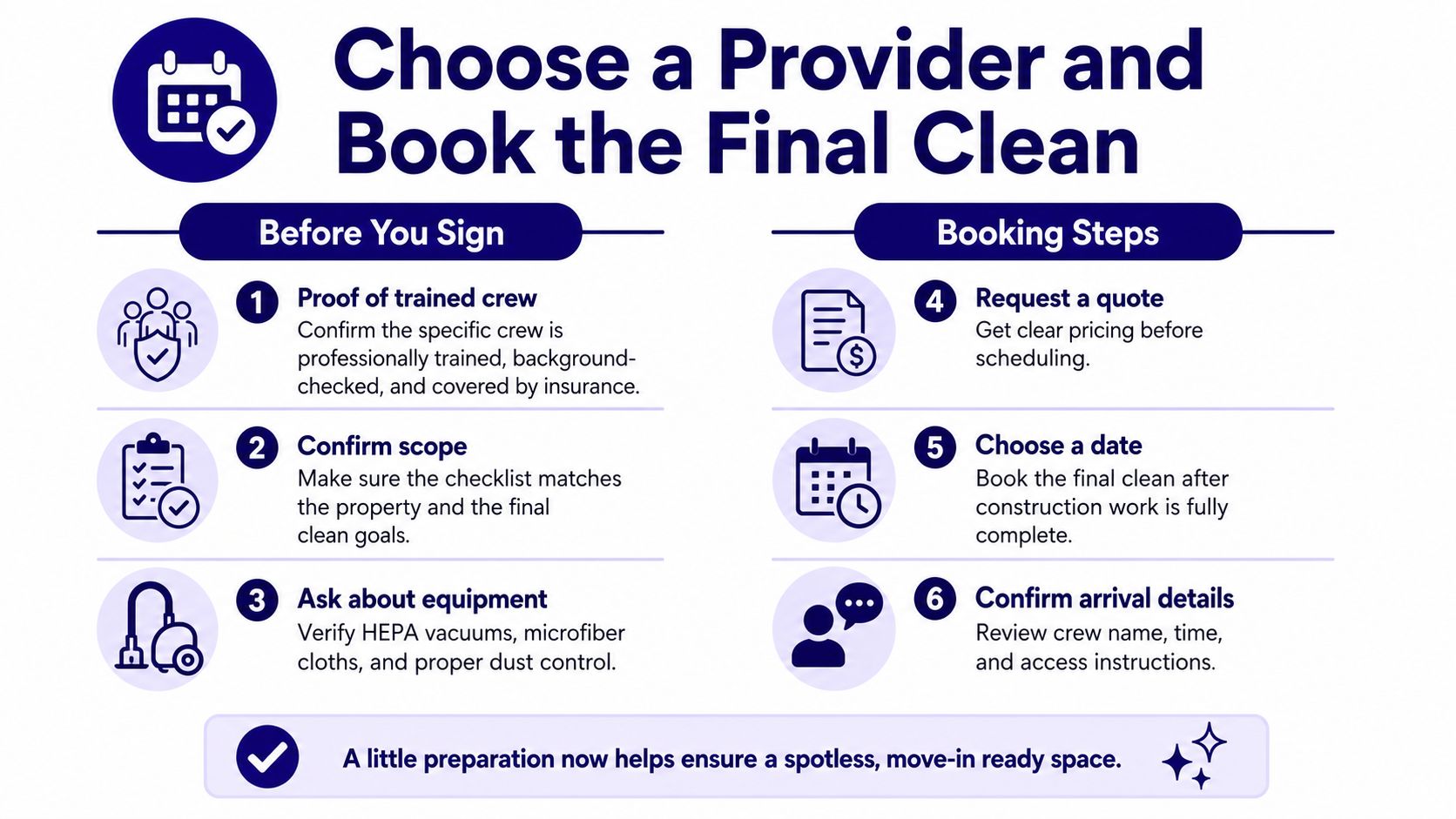
Price comparisons fail when every quote covers different work. One bid includes inside cabinets and windows, another skips both, and the cheaper number wins until you pay for add-ons. Run the checks below against the same written scope, and compare at least three quotes before you sign.
<a id="seven-checks-before-you-sign"></a>
Seven Checks Before You Sign
Check 1, crew credentials. Confirm the specific crew coming to your home is professionally trained, background-checked, and covered by general liability insurance. Company-level claims don't help if an unknown subcontractor shows up. All of our cleaning specialists are professionally trained, background-checked, and covered by our general liability insurance.
Check 2, written scope. Get rooms, surfaces, exterior windows, garage, and add-ons such as inside ovens or refrigerators listed in writing. If inside cabinets matter for move-in, they should appear by name, not under a vague promise of detailing.
Check 3, equipment on site. Confirm sealed HEPA vacuums and fresh microfiber will be used in your home, not just owned by the company. Ask which machine handles fine dust in finished rooms.
Check 4, pricing basis. Price usually follows home size, bathroom count, scope, and add-ons. Every quote should state what it excludes. For a benchmark, our Post-Construction Cleaning starts at $665 as a one-time cleaning in Orlando and Central Florida. If you're weighing bids by area, post-construction cleaning rates per square foot gives you a way to normalize quotes across different home sizes.
Check 5, re-clean and refund policy. Compare this across providers before booking, not after a disappointing visit. We return within 24 hours to re-clean any spot that doesn't meet your standard at no charge. Ask any provider for their equivalent window in writing.
Check 6, no clearance promises. A provider shouldn't guarantee regulatory clearance or lead testing results from cleaning alone. They can document visible completion and prepare the property for separate verification.
Check 7, scheduling fit. Confirm the crew can start after the last trade leaves and, where possible, before the HVAC system restarts. Availability on the wrong day is worth less than a slightly later slot in the right sequence.
<a id="booking-steps-that-prevent-handover-problems"></a>
Booking Steps That Prevent Handover Problems
Lock the scope in writing with a photo record of starting condition, including existing paint specks, adhesive spots, or damaged finishes. Confirm running hot water, working electricity, and indoor temperature control will be available during the clean, since crews can't damp-wipe, vacuum, or work safely without them. Arrange access by lockbox, keypad, or front-desk key if you won't be there, and confirm who secures the home afterward.
Schedule so a touch-up day remains between the final clean and inspection or move-in. Walk-throughs, appliance deliveries, and last hardware installs all create fresh fingerprints and dust. That buffer day is where a punch-list pass earns its cost.
Keep the written scope, photo log, and quote together in one folder for the inspector or buyer walk-through. When someone asks what was cleaned and when, you'll have an answer instead of a memory.
One last trade-off to weigh: the lowest quote often achieves its price by cutting the dust pass, reusing cloths, or using a coarse shop vacuum in finished rooms. None of those shortcuts show up in photos. They show up a week later as dust lines on shelves, grit in drawers, and a filter clogged with construction particulate. Pay for the sequence and the equipment, document the result, and treat clearance as a separate question with its own qualified answer.
---
If your Orlando remodel is finished but the dust isn't, J&M Cleaning Team offers post-construction cleaning that removes fine dust and debris to prepare your home for final inspection or move-in, with trained, background-checked specialists who bring their own commercial-grade equipment. Get your flat-rate quote and book your final clean with J&M Cleaning Team before the furniture goes in, while every surface is still easy to reach.