

You've received two cleaning quotes for the same home, and the gap is large enough to make one of them look wrong. One company gives you a low hourly rate. Another sends a higher flat total with a detailed checklist. The cheaper quote may be the better deal, but only if both companies are promising the same result.
That's the problem with comparing cleaning services estimates by price alone. A professional quote covers labor, travel, supplies, supervision, insurance, scheduling, and the actual scope of work. If any of those items remain vague, the headline price tells you very little.
Table of Contents
- [Why Cleaning Service Estimates Vary So Much](#why-cleaning-service-estimates-vary-so-much)
- [The hourly rate is only one input](#the-hourly-rate-is-only-one-input)
- [Regional Market Factors in Florida Pricing](#regional-market-factors-in-florida-pricing)
- [Flat-Rate Versus Hourly Pricing Models](#flat-rate-versus-hourly-pricing-models)
- [When flat rates work best](#when-flat-rates-work-best)
- [When hourly pricing makes sense](#when-hourly-pricing-makes-sense)
- [How to Build a Defensible Estimate](#how-to-build-a-defensible-estimate)
- [Start with measurable inputs](#start-with-measurable-inputs)
- [Separate cleaning from support work](#separate-cleaning-from-support-work)
- [Sample Service Categories and Scope Definitions](#sample-service-categories-and-scope-definitions)
- [Standard cleaning](#standard-cleaning)
- [Deep cleaning](#deep-cleaning)
- [Move-in and move-out cleaning](#move-in-and-move-out-cleaning)
- [Post-construction cleaning](#post-construction-cleaning)
- [Understanding Add-Ons and Specialized Tasks](#understanding-add-ons-and-specialized-tasks)
- [Common additions](#common-additions)
- [Where budget cuts fail](#where-budget-cuts-fail)
- [The Hidden Cost of Neglected Small Surfaces](#the-hidden-cost-of-neglected-small-surfaces)
- [Why small surfaces create large disputes](#why-small-surfaces-create-large-disputes)
- [Inspection risk changes the priority](#inspection-risk-changes-the-priority)
- [Checklist for Evaluating Cleaning Estimates](#checklist-for-evaluating-cleaning-estimates)
<a id="why-cleaning-service-estimates-vary-so-much"></a>
Why Cleaning Service Estimates Vary So Much
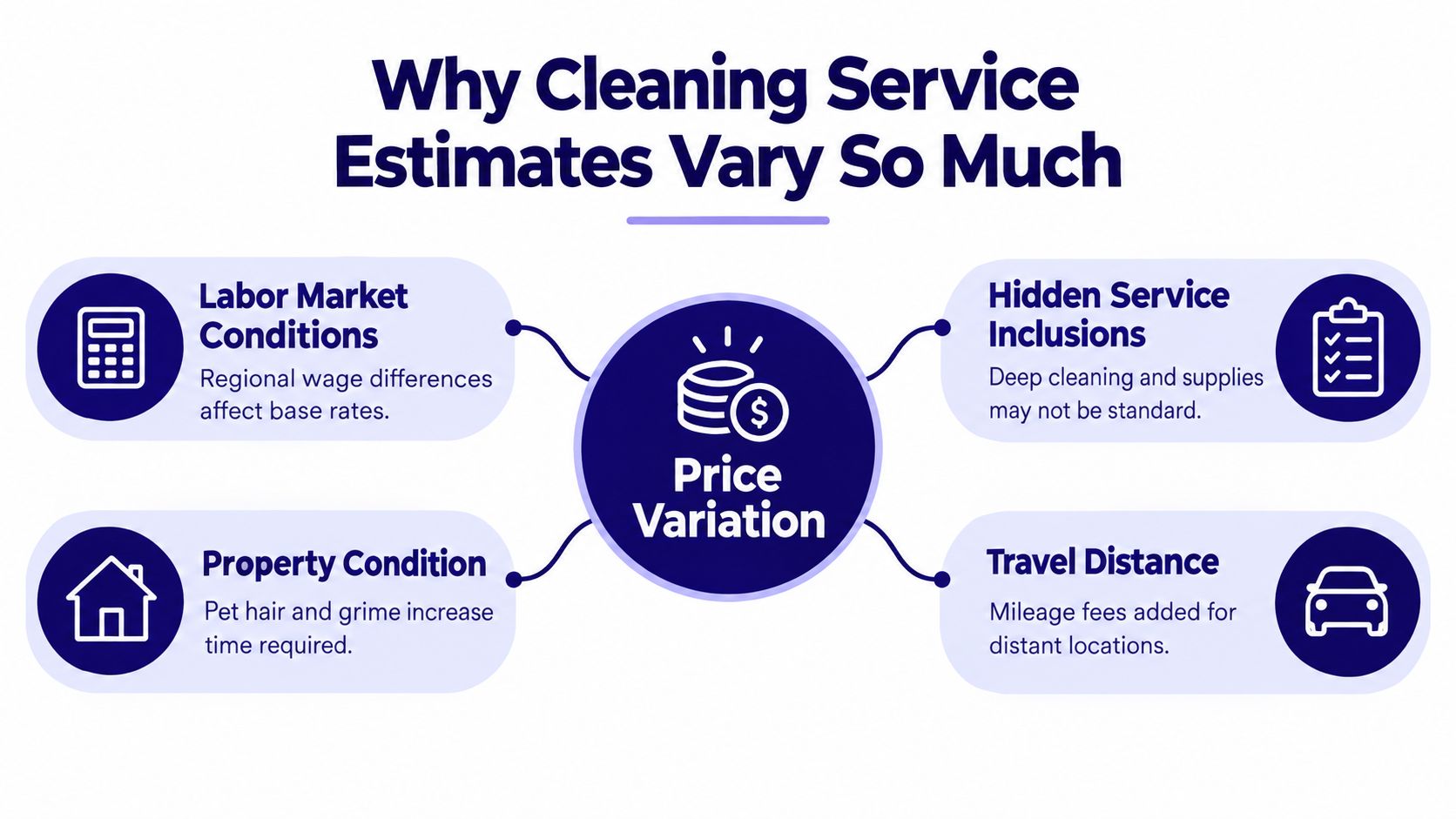
A homeowner requests a deep clean, and two cleaners define it differently. One includes dusting, vacuuming, mopping, and bathroom work. Another adds baseboards, appliance interiors, cabinet fronts, and difficult buildup. The label is identical. The labor is not.
That difference drives the estimate. Cleaning time changes with home size, bathroom count, clutter, soil level, pets, flooring, access, and crew size. The U.S. Bureau of Labor Statistics employment and wage data reported 854,910 maids and housekeeping cleaners employed in May 2024, with an annual mean wage of $36,180. Those figures describe employee compensation, not the customer's final bill. The company must also recover travel, supervision, insurance, supplies, scheduling, and office costs.
<a id="the-hourly-rate-is-only-one-input"></a>
The hourly rate is only one input
An hourly figure may exclude travel between jobs, equipment loading, arrival setup, communication, quality control, paid leave, insurance, supplies, and administration. A higher rate can include those costs directly. A low advertised rate may shift them into minimum hours, add-ons, or a revised invoice.
Historical wage data also expose outdated pricing assumptions. The mean hourly wage for this occupation rose from $11.46 in May 2016 to $16.66 in May 2023, an increase of about 45%, while reported employment fell by roughly 10%, according to the same BLS data series. A defensible quote must reflect current labor conditions and the work required.
Practical rule: If a quote omits the service scope, number of cleaners, expected duration, and possible add-ons, you are comparing labels rather than value.
Read the estimate for its deliverables. A transparent flat rate should identify included rooms, task limits, access assumptions, and exclusions. An hourly quote should state what the team expects to complete within the paid time and how the company will seek approval if the scope expands. Cheap labor rarely fixes an undefined scope. Clear definitions do.
<a id="regional-market-factors-in-florida-pricing"></a>
Regional Market Factors in Florida Pricing
A cleaning quote for an Orlando home can change when the service area, appointment density, or property layout changes. Florida estimates require local assumptions about labor, driving time, access, and the amount of detail expected. A generic national price offers little protection if those assumptions remain unstated.
Florida's historical occupation data show why labor conditions belong in the estimate. In May 2016, the state reported approximately 82,510 maids and housekeeping cleaners, with a mean hourly wage of $10.50. In May 2017, it reported 81,500 workers and a mean wage of $10.82. By May 2019, the figures were 80,000 workers and $11.60 per hour. The Florida occupation data from the Bureau of Labor Statistics record a mean-wage increase of approximately 10.5% from 2016 to 2019, while employment declined by about 3.0%.
Those figures do not set a current Orlando price. They show why a company must calculate labor time against local operating conditions. A route with tightly grouped appointments supports a different cost structure from one requiring long drives between scattered homes. Congestion, parking, equipment transport, and schedule gaps all consume paid labor without adding visible cleaning time.
A provider serving Central Florida should explain how those conditions affect scheduling or fees. Review its Central Florida cleaning service coverage, then ask what the estimate assumes about travel and access. Home size, bathrooms, flooring, occupancy, pets, condition, and requested detail work can change the crew-hours required.
Ask, “What labor and travel assumptions support this total?” If the answer is missing, the low price is promotional, not defensible.
<a id="flat-rate-versus-hourly-pricing-models"></a>
Flat-Rate Versus Hourly Pricing Models
Flat-rate and hourly billing solve different problems. Hourly pricing protects flexibility when the scope is uncertain. Flat-rate pricing protects budget certainty when the scope is clearly defined. Neither model is automatically honest or dishonest. The written deliverable determines that.
| Feature | Flat-Rate | Hourly |
|---|---|---|
| Budget predictability | Total is known before scheduling when scope is documented | Final total depends on time used |
| Best fit | Recurring maintenance, standard homes, move-in or move-out work with clear conditions | Unpredictable condition, selected tasks, or an open-ended cleanup |
| Customer risk | The company may exclude detail work or limit time if the quote is vague | The customer may pay more if the job takes longer |
| Company incentive | Efficient production supports the agreed margin | Additional time increases the invoice, subject to any limit |
| What to verify | Included rooms, tasks, exclusions, add-ons, and condition assumptions | Hourly rate, minimum time, crew size, time cap, and approval process |
<a id="when-flat-rates-work-best"></a>
When flat rates work best
A flat rate is the stronger choice for a maintained home with a defined checklist. It's also useful when you're preparing for a move, listing, turnover, or recurring schedule and need to know the total before approving the job.
The company still has to calculate the price from expected labor. It shouldn't just guess from bedroom count. A sound estimate accounts for cleanable area, bathrooms, condition, occupants, flooring, access, and the difference between productive cleaning and support time. Review the service descriptions on cleaning packages and service options, then compare the wording with the quote you received.
<a id="when-hourly-pricing-makes-sense"></a>
When hourly pricing makes sense
Hourly billing can be appropriate when you want a limited block of work, such as organizing a specific area, removing unusual residue, or addressing a property whose condition can't be assessed reliably in advance. It gives you flexibility, but you need a stopping rule.
Ask whether the team will pause at a time limit, request approval before exceeding it, or continue until the requested tasks are complete. Also confirm whether the quoted hourly rate applies per cleaner or to the crew. A low rate attached to several cleaners can produce a higher total than expected.
A cheap hourly rate with an undefined endpoint isn't a budget. It's an open invoice.
<a id="how-to-build-a-defensible-estimate"></a>
How to Build a Defensible Estimate
Professional estimators should convert property conditions into labor time. The useful framework starts with cleanable square footage, then adjusts for production rate, task complexity, condition, and support time.

<a id="start-with-measurable-inputs"></a>
Start with measurable inputs
Collect the facts that change production:
- Home size: Use cleanable area, not just the number of bedrooms.
- Bathrooms: Bathrooms usually require more detailed labor than open living areas.
- Service type: Standard, deep, move-in/out, and post-construction work need different assumptions.
- Condition: Heavy soil, clutter, grease, pet hair, and neglected surfaces reduce productivity.
- Occupancy: Furnished homes require more navigation and surface handling than vacant properties.
- Flooring mix: Carpet, tile, hardwood, stairs, and specialty finishes create different task demands.
- Add-ons: Oven interiors, refrigerator interiors, interior windows, and extensive baseboard work should be priced separately when they aren't part of the base scope.
The calculation used in ISSA's cleaning-times guidance is:
Estimated labor minutes = cleanable square footage ÷ production rate per hour × 60
ISSA treats cleaning-time data as a bidding and estimating benchmark, not as a guaranteed time-motion study. That distinction matters. A production rate is a starting assumption that must be adjusted for the actual home.
<a id="separate-cleaning-from-support-work"></a>
Separate cleaning from support work
The estimate should distinguish productive cleaning from travel, arrival setup, supply loading, communication, and quality-control time. If the company counts only time spent wiping surfaces, it may underprice the job. If it rolls every activity into an unexplained hourly figure, you can't evaluate the quote.
Use actual job records to improve accuracy. Record labor minutes by service category, home size, and condition. Compare the estimate with the completed job, then adjust future assumptions. A recurring visit should usually follow a starter or reset clean because accumulated soil and neglected detail work can slow the first service.
The video below illustrates the practical estimating mindset, measuring work rather than relying on a room count alone.
<iframe width="100%" style="aspect-ratio: 16 / 9;" src="https://www.youtube.com/embed/8S9WcItZsyQ" frameborder="0" allow="autoplay; encrypted-media" allowfullscreen></iframe>
A defensible estimate ends with scope notes. State what's included, excluded, and available as an add-on. That document gives the customer a clear deliverable and gives the cleaning team a fair labor target.
<a id="sample-service-categories-and-scope-definitions"></a>
Sample Service Categories and Scope Definitions
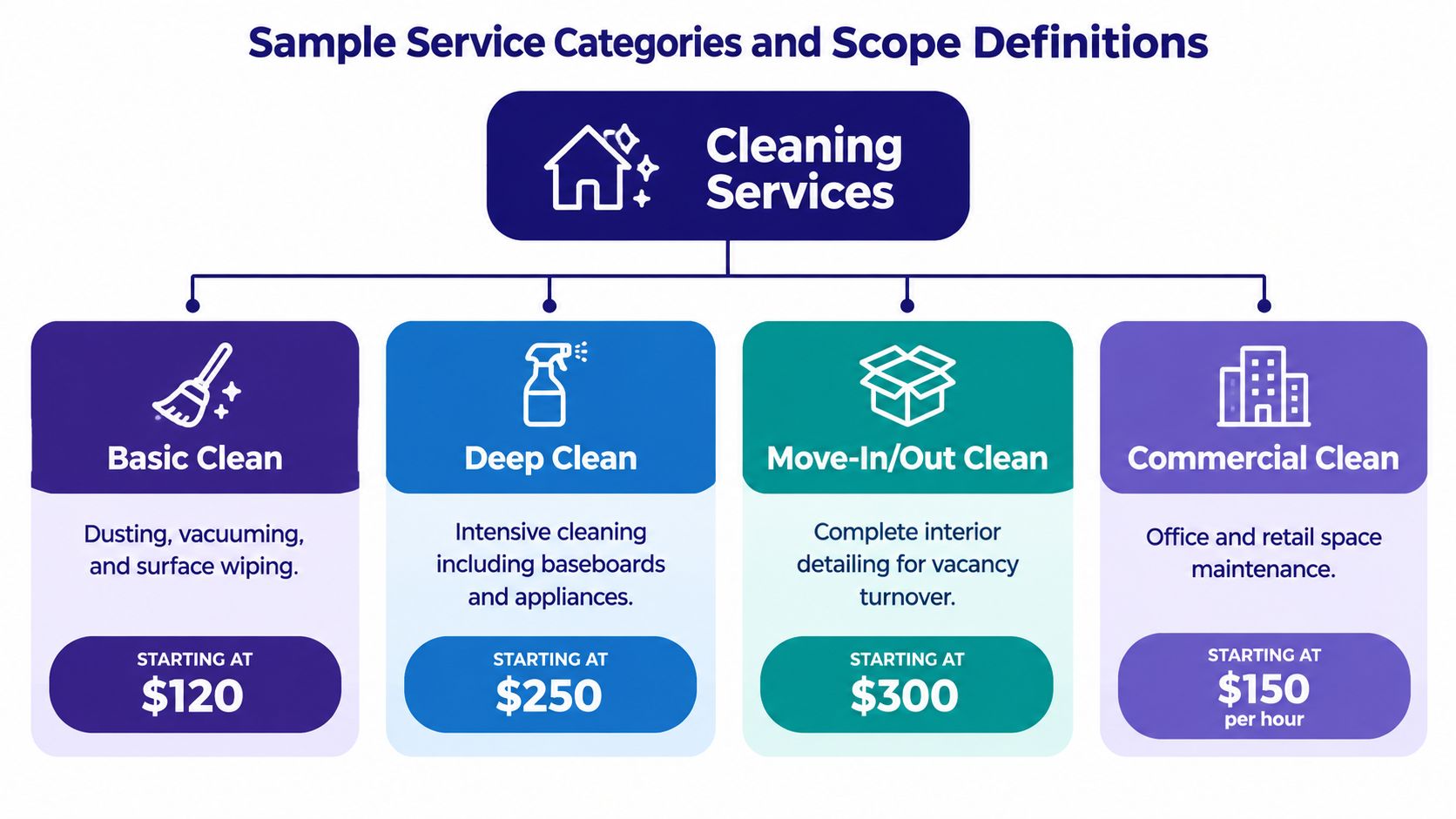
“Clean” isn't a sufficient service description. A maintenance visit, a reset clean, a vacancy turnover, and a post-construction cleanup involve different surfaces, priorities, and production assumptions.
<a id="standard-cleaning"></a>
Standard cleaning
A standard clean maintains a home that's already in reasonable condition. The usual scope includes visible-surface dusting, vacuuming, mopping, kitchen surface cleaning, bathroom cleaning, and routine trash removal. It shouldn't be expected to remove extensive buildup or restore neglected detail areas.
<a id="deep-cleaning"></a>
Deep cleaning
A deep clean resets a home after cleaning has lapsed or buildup has accumulated. The estimate may include more detailed work on baseboards, fixtures, grout, reachable ledges, cabinet fronts, and selected appliance areas. The quote must identify whether appliance interiors, blinds, interior windows, and behind-furniture work are included, because “deep” has no universal task list.
<a id="move-in-and-move-out-cleaning"></a>
Move-in and move-out cleaning
A vacancy clean focuses on interior access and turnover readiness. Empty rooms make it easier to reach cabinets, closets, floors, trim, and fixtures, but the expectation is also higher. Renters may need detail work for an inspection, while property managers and agents may need a consistent presentation standard.
<a id="post-construction-cleaning"></a>
Post-construction cleaning
Post-construction work is not just a more aggressive deep clean. Fine dust, debris, adhesive, paint residue, and construction film may require specialized tools, careful surface selection, and multiple passes. Natural stone, specialty finishes, and delicate flooring need manufacturer-approved products.
The cost difference between categories comes from labor hours and task coverage, not from the name printed on the estimate. A recurring maintenance visit can protect the baseline. A reset, turnover, or renovation cleanup has to recover work that routine service doesn't address.
<a id="understanding-add-ons-and-specialized-tasks"></a>
Understanding Add-Ons and Specialized Tasks
Add-ons create fewer disputes when the estimate names them before scheduling. They also give you control. You can pay for the tasks that matter most instead of accepting an oversized package or discovering later that the most visible details were excluded.
<a id="common-additions"></a>
Common additions
Oven interiors involve grease, baked-on residue, racks, doors, and surrounding surfaces. Refrigerator interiors require emptying or preparing the appliance, removing shelves where appropriate, and allowing time for detailed wiping. Interior windows may include glass, tracks, frames, or sills, and those are separate levels of work.
Baseboard detailing is another frequent boundary. A standard visit may address accessible, lightly soiled trim, while heavy buildup, delicate finishes, or extensive hand-detailing may require additional labor. Blinds, ceiling fans, cabinet interiors, laundry, and wall marks should receive the same treatment: define them, price them, or exclude them clearly.
Post-renovation residue deserves special attention. Review the scope for post-construction cleaning services when drywall dust, adhesive, paint specks, or fine debris remains. A team may need more than one pass, and the estimate should say whether residue removal is included or assessed separately.
<a id="where-budget-cuts-fail"></a>
Where budget cuts fail
Cutting the wrong add-on often leaves the property looking unfinished. Skipping an oven interior may be sensible for routine maintenance, but it's a poor choice before a rental inspection if the appliance is part of the handover standard. Skipping interior windows may be reasonable for a quick upkeep visit, but not for a listing where glass and sills are prominent.
Ask the cleaner to separate core maintenance, detail work, and specialty treatment. That structure lets you reduce scope without pretending the same result will cost less.
<a id="the-hidden-cost-of-neglected-small-surfaces"></a>
The Hidden Cost of Neglected Small Surfaces
Customers often judge a room by surfaces that don't appear in a headline checklist. Baseboards, blinds, sills, fans, shower glass, and appliance edges occupy little space, but they collect visible dust and residue.
A December 2024 survey of 2,000 Americans found that window blinds were the least-maintained area for 29% of respondents. The same Newsweek report on household cleaning habits identified windowsills at 24%, ceiling fans at 23%, and baseboards at 27%. These figures don't price a cleaning job, but they show why customers and cleaners often disagree about what “complete” means.
<a id="why-small-surfaces-create-large-disputes"></a>
Why small surfaces create large disputes
A standard checklist may promise dusting, but customers may interpret that as blinds, fan blades, trim, and ledges. A cleaner may interpret it as accessible horizontal surfaces. Neither interpretation is safe for a move-out, listing, or final inspection.
The estimate should identify detail surfaces separately:
- Baseboards: Light dusting, damp wiping, or heavy hand-scrubbing?
- Blinds: Dusting only, or wet cleaning for accumulated residue?
- Ceiling fans: Reachable blades and housings, or excluded because of height?
- Windows: Glass only, or frames, tracks, screens, and sills?
- Appliances: Exterior surfaces, or interior cleaning as an add-on?
- Shower glass: Surface wiping, mineral buildup treatment, or specialty restoration?
<a id="inspection-risk-changes-the-priority"></a>
Inspection risk changes the priority
Renters, landlords, agents, and builders shouldn't choose a quote based only on room coverage. Overlooked detail areas can affect how a property appears during a walkthrough, turnover inspection, listing preparation, or move-in review.
Scope advice: Ask for a room-by-room checklist with a separate line for neglected detail surfaces. Honest exclusions are more useful than a low price that implies work nobody agreed to perform.
<a id="checklist-for-evaluating-cleaning-estimates"></a>
Checklist for Evaluating Cleaning Estimates
Use the estimate as an operations document, not a casual text message. Before booking, verify the conditions that determine labor, the tasks that define the result, and the charges that can change the total.
1. Confirm the service category. Is the quote for standard maintenance, deep cleaning, move-in/out, or post-construction work? Don't accept a generic “whole-house cleaning” label.
2. Record the property inputs. Check the stated home size, bathroom count, occupancy, pets, flooring, stairs, access instructions, and condition.
3. Read the task list. Look for kitchens, bathrooms, floors, visible surfaces, trim, fixtures, cabinets, appliances, windows, and trash removal.
4. Separate included work from add-ons. Oven interiors, refrigerator interiors, interior windows, blinds, fans, and extensive baseboard detailing should be named explicitly.
5. Ask about labor assumptions. Confirm crew size, estimated labor time, arrival window, and whether travel or setup is included.
6. Check the total price. Make sure the quote shows the final amount before scheduling, including supplies, taxes where applicable, access charges, and any minimum.
7. Clarify condition changes. Ask what happens if the team finds construction residue, heavy grease, excessive clutter, inaccessible areas, or damage requiring special handling.
8. Verify product controls. For family- or pet-safer requests, ask whether the company uses products carrying the EPA Safer Choice label, follows manufacturer dilution and contact-time instructions, and documents product labels and safety data sheets.
9. Define quality control. Find out who reviews completed work and how you report an omitted task.
10. Compare deliverables, not headlines. Put competing estimates side by side and mark every difference in scope, labor assumption, access condition, and add-on treatment.
The best estimate makes the final result predictable. If the provider can't explain what the team will do, how the labor was calculated, and what could change the scope, keep looking.
---
J&M Cleaning Team provides transparent flat-rate estimates for standard, deep, move-in/out, recurring, and post-construction cleaning across Orlando and Central Florida. Visit J&M Cleaning Team to review the service options, get an online quote, and schedule a clearly defined cleaning visit.